How to Turn CCNA 200-301 Practice Questions into a Targeted Study Plan
Preparing for the Cisco CCNA 200-301 exam involves more than answering practice questions and counting correct answers. The real value comes from understanding why you missed a question and deciding what to work on next.
A practice test can reveal that subnetting, routing, VLANs, or network troubleshooting needs attention. But a wrong answer alone doesn’t tell you whether you forgot a rule, confused two concepts, struggled to apply your knowledge, or overlooked a critical detail in the question.
This guide shows you how to turn 50 free CCNA practice questions into a practical study plan. Instead of reviewing every topic equally, you’ll learn to identify the cause of each mistake, choose a focused review activity, and test whether your understanding has actually improved.
Before You Start: Check Your CCNA Exam Version
Your practice questions should match the exam you’re preparing to take. Cisco’s current schedule states that the last testing date for CCNA 200-301 v1.1 is February 2, 2027, while CCNA v2.0 begins testing on February 3, 2027. The updated exam includes changes to topic coverage, including greater emphasis on network infrastructure and connectivity, as well as AI-related network operations. Check Cisco’s official CCNA certification information and v2.0 exam topics before choosing your preparation materials.
Don’t assume that a question set written for v1.1 provides complete coverage of v2.0. The fundamentals you learn remain useful, but you should verify that your practice materials address the objectives for your actual exam date.
How to Use the 50 CCNA Practice Questions
Treat this first attempt as a diagnostic exercise, not a race to achieve a high score. Work through the questions independently, avoid checking answers prematurely, and record any answer you guessed or selected without being able to explain your reasoning.
When you finish, keep three details for each question: your answer, whether you were confident, and the topic involved. Confidence matters because a correct guess and a correct answer supported by sound reasoning are not equivalent. Likewise, an incorrect answer that exposes a fundamental misunderstanding requires a different response from one caused by a small calculation error.
Don’t immediately reread the entire study guide after checking your results. First, identify the mistakes that deserve investigation. That step will help you spend your limited study time on the actual problems rather than on material you already understand.
50 Free CCNA 200-301 online Practice Questions
| More verification methods | Tips | Verify Answer |
| Interactive online format that closely simulates a real-world environment: https://www.leads4pass.com/200-301/engine.html | Here are the latest questions; you can click the link on the side to verify the answers. | Verification address:https://www.leads4pass.com/200-301/questions.html |
Question 1
Multiple choice
Which two QoS tools are used to guarantee minimum bandwidth to certain traffic ?(choose two)
A.FIFO
B.LLC
C.CBWFQ
D.RSVP
E.WFQ
Question 2
Single choice
What occurs when overlapping Wi-Fi channels are implemented?
A.The wireless network becomes vulnerable to unauthorized access.
B.Wireless devices are unable to distinguish between different SSIDs
C.Users experience poor wireless network performance.
D.Network communications are open to eavesdropping.
Question 3
Single choice
Refer to the exhibit.
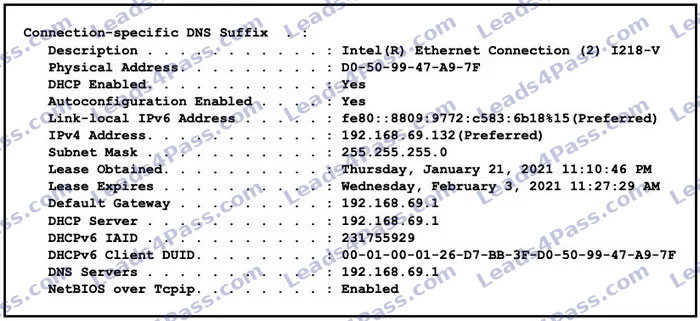
What does the host do when using the IPv4 Preferred function?
A.It forces the DNS server to provide the same IPv4 address at each renewal.
B.It requests the same IPv4 address when it renews its lease with the DHCP server.
C.It prefers a pool of addresses when renewing the IPv4 host IP address.
D.It continues to use a statically assigned IPv4 address.
Question 4
Single choice
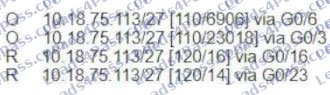
Which interface is used to send traffic to the destination network?
Preview image: watermark not included in purchased products.
A.G0/6
B.G0/3
C.G0/16
D.G0/23
Question 5
Single choice
Which value is used to determine the active router in an HSRP default configuration?
A.Router loopback address
B.Router IP address
C.Router priority
D.Router tracking number
Question 6
Single choice
Which global command encrypt all passwords in the running configuration?
A.password-encrypt
B.enable password-encryption
C.enable secret
D.service password-encryption
Question 7
Drag and drop
DRAG DROP
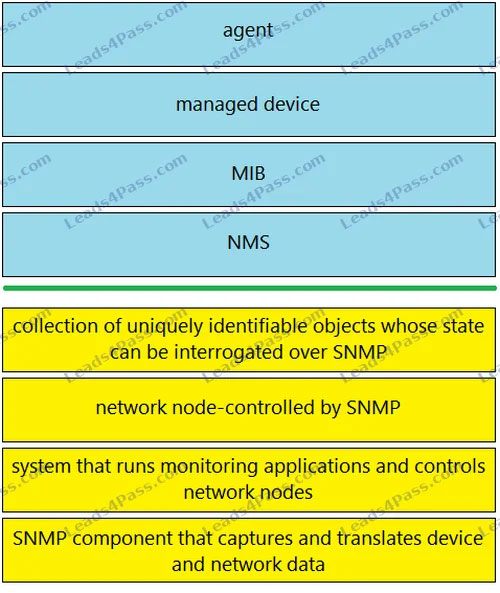
Drag and drop the SNMP components from the left onto the descriptions on the right.
Question 8
Single choice
Refer to the exhibit.
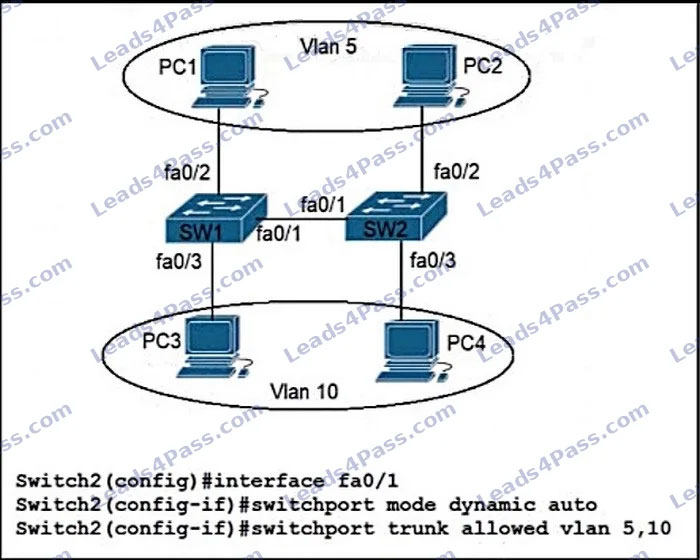
SW2 is replaced due to a hardware failure. A network engineer starts to configure SW2 by copying the Fa0/1 interface configuration from SW1.
Which command must be configured on the Fa0/1 interface of SW2 to enable PC1 to connect to PC2?
A.switchport mode trunk
B.switchport trunk native vlan 10
C.switchport trunk allowed remove 10
D.switchport mode access
Question 9
Single choice
Which command is used to specify the delay time in seconds for LLDP to initialize on any interface?
A.lldp timer
B.lldp tlv-select
C.lldp reinit
D.lldp holdtime
Question 10
Single choice
What does a switch do when it receives a frame whose destination MAC address is missing from the MAC address table?
A.It floods the frame unchanged across all remaining ports in the incoming VLAN.
B.It appends the table with a static entry for the MAC and shuts down the port.
C.It updates the CAM table with the destination MAC address of the frame.
D.It changes the checksum of the frame to a value that indicates an invalid frame.
Question 11
Drag and drop
DRAG DROP
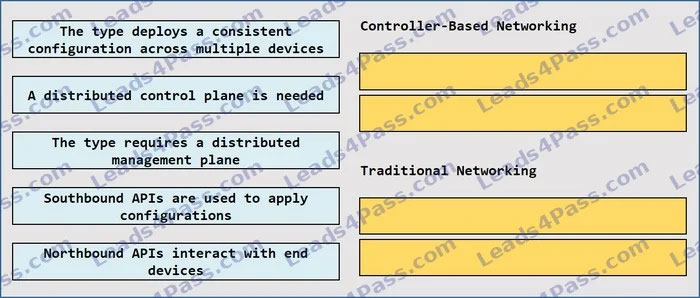
Drag and drop the statement about networking from the left into the Corresponding networking types on the right. Not all statements are used.
Question 12
Single choice
Which role does AI play in monitoring network data flow?
A.It enhances data packet delivery speeds.
B.It exclusively predicts device malfunctions.
C.It simplifies traffic route mapping.
D.It analyzes patterns for anomaly detection.
Question 13
Single choice
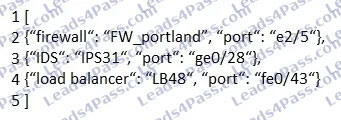
What is represented by the word “IDS” within this JSON schema?
A.object
B.value
C.array
D.key
Question 14
Single choice
Which management security process is invoked when a user logs in to a network device using their username and password?
A.authentication
B.auditing
C.accounting
D.authorization
Question 15
Multiple choice
What are two roles of the Dynamic Host Configuration Protocol (DHCP)? (Choose two.)
A.The DHCP server assigns IP addresses without requiring the client to renew them.
B.The DHCP server leases client IP addresses dynamically.
C.The DHCP client can request up to four DNS server addresses.
D.The DHCP server offers the ability to exclude specific IP addresses from a pool of IP addresses.
EThe DHCP client maintains a pool of IP addresses it can assign.
Question 16
Drag and drop
DRAG DROP
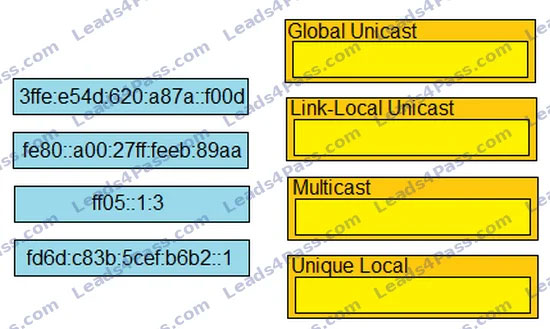
Drag and drop the IPv6 addresses from the left onto the corresponding address types on the right.
Question 17
Single choice
Refer to the exhibit.
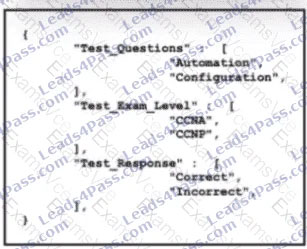
How many objects, keys and JSDN list values are present?
A.three objects, two keys, and three JSDN list values
B.three objects, three keys and two JSDN Ml values
C.one object, three keys, and three JSDN list values
D.one object, three keys and two JSDN list values
Question 18
Single choice
Which command verifies the operational status of interfaces on a Cisco router?
A.show ip protocols
B.show interfaces
C.show ip route
D.show running-config
Question 19
Lab simulation
Simulation
Guidelines
This is a lab item in which tasks will be performed on virtual devices
1. Refer to the Tasks tab to view the tasks for this lab item.
2. Refer to the Topology tab to access the device console(s) and perform the tasks.
3. Console access is available for all required devices by clicking the device icon or using the tab(s) above the console window.
4. All necessary preconfigurations have been applied.
5. Do not change the enable password or hostname for any device.
6. Save your configurations to NVRAM before moving to the next item.
7. Click Next at the bottom of the screen to submit this lab and move to the next question.
8. When Next is clicked the lab closes and cannot be reopened.
Topology
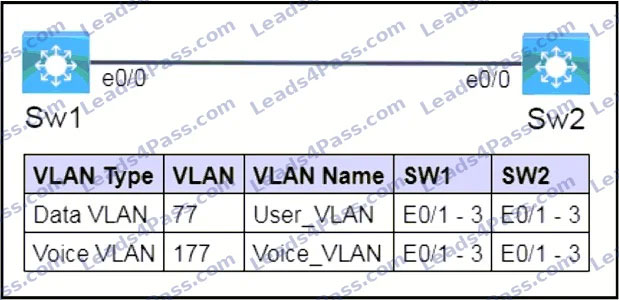
Tasks
All physical cabling is in place and verified. Connectivity for the Switches on ports E0/1, E0/2, and E0/3 must be configured and available for voice and data capabilities.
1. Configure Sw1 and Sw2 with both VLANS, naming them according to the VLAN Name provided in the topology.
2. Configure the E0/1, E0/2, and E0/3 ports on both switches for both VLANS and ensure that Cisco IP phones and PCs pass traffic.
3. Configure Sw1 and Sw2 to allow neighbor discovery via the vendor-neutral protocol on e0/0.
Question 20
Single choice
What is the collapsed layer in collapsed core architectures?
A.core and distribution
B.distribution and access
C.core and WAN
D.access and WAN
Question 21
Drag and drop
DRAG DROP
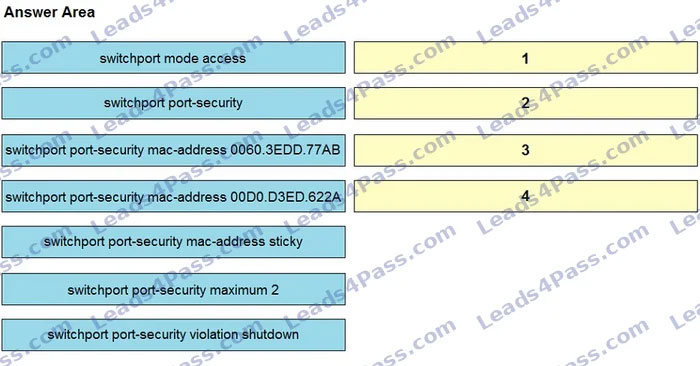
An engineer is tasked to configure a switch with port security to ensure devices that forward unicasts,multicasts,and broadcasts are unable to flood the port.The port must be configured to permit only two random MAC addresses at a time.Drag and drop the required configuration commands from the left onto the sequence on the right.(not all commands are used)
Question 22
Single choice
Which EtherChannel mode must be configured when using LAG on a WLC?
A.on
B.passive
C.active
D.auto
Question 23
Drag and drop
DRAG DROP
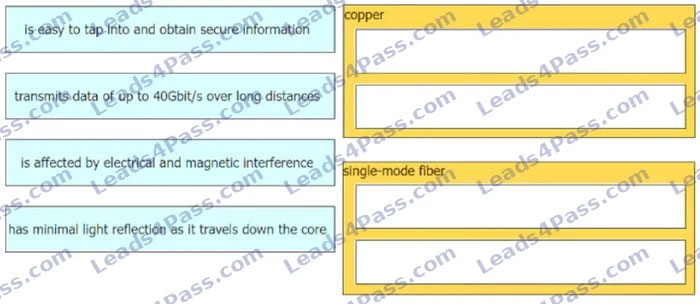
Drag and drop the characteristic from the left onto the cable type on the right.
Question 24
Single choice
Refer to the exhibit.
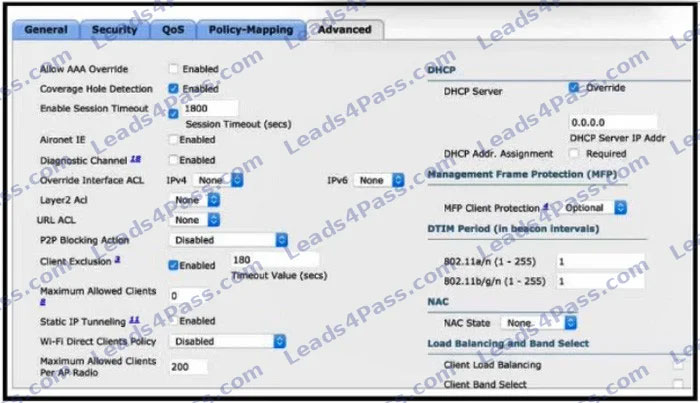
The P2P blocking action option is disabled on the WLC.The security team has a new requirement for each client to retain their assigned IP addressing as the clients move between locations in the campus network.
Which action completes this configuration?
A.Enable the Static IP Tunneling option.
B.Disable the Coverage Hole Detection option.
C.Check the DHCP Addr. Assignment check box.
D.Set the P2P Blocking Action option to Forward-UpStream.
Question 25
Multiple choice
Which two components are part of the control plane of a router? (Choose two.)
A.Routing table calculation
B.Frame forwarding
C.Path selection
D.CRC generation
E.Packet queuing
Question 26
Single choice
Refer to the exhibit.
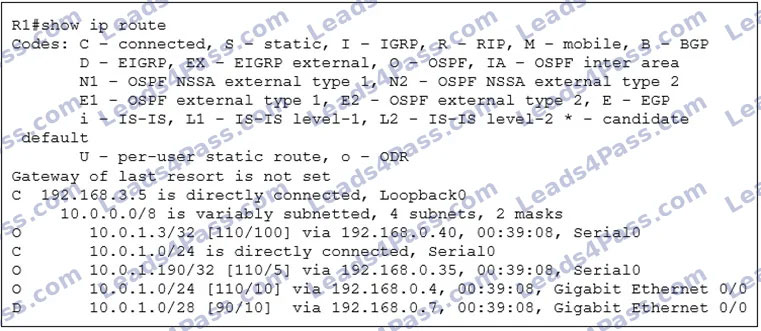
Traffic sourced from the loopback0 interface is trying to connect via ssh to the host at 10.0.1.15.
What is the next hop to the destination address?
A.192.168.0.7
B.192.168.0.4
C.192.168.0.40
D.192.168.3.5
Question 27
Single choice
What is the primary purpose of a recursive query in DNS?
A.to perform a reverse DNS lookup
B.to update DNS records on a server
C.to refresh the TTL of specific DNS records
D.to resolve domain names via multiple DNS servers
Question 28
Single choice
Refer to the exhibit.
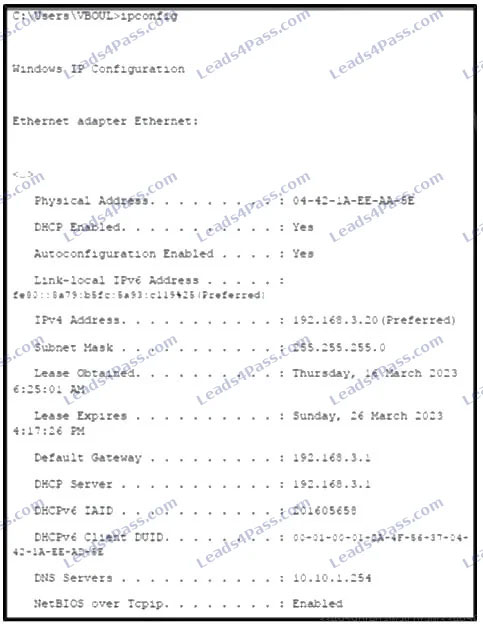
The user has connectivity to devices on network 192.168.3.0/24 but cannot reach users on the network 10.10.1.0/24.
What is the first step to verify connectivity?
A.Is the internet reachable?
B.Is the default gateway reachable?
C.Is the DNS server reachable?
D.Is the IPv4 address reachable?
Question 29
Multiple choice
Which two events occur automatically when a device Is added to Cisco DNA Center? (Choose two.)
A.The device Is assigned to the Global site.
B.The device Is placed into the Unmanaged state.
C.The device Is placed into the Provisioned state.
D.The device Is placed into the Managed state.
E.The device is assigned to the Local site.
Question 30
Single choice
Which device protects an internal network from the Internet?
A.router
B.firewall
C.access point
D.Layer 2 switch
Question 31
Drag and drop
DRAG DROP
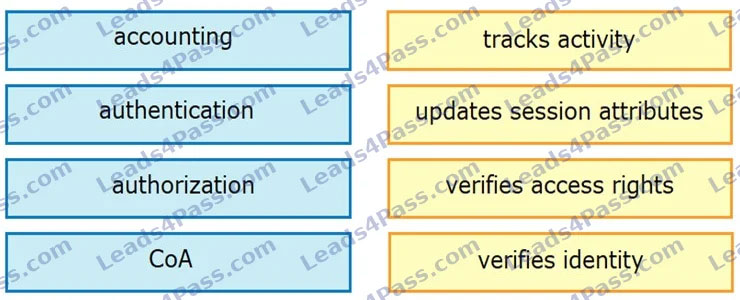
Drag and drop the AAA terms from the left onto the descriptions on the right.
Question 32
Drag and drop
DRAG DROP
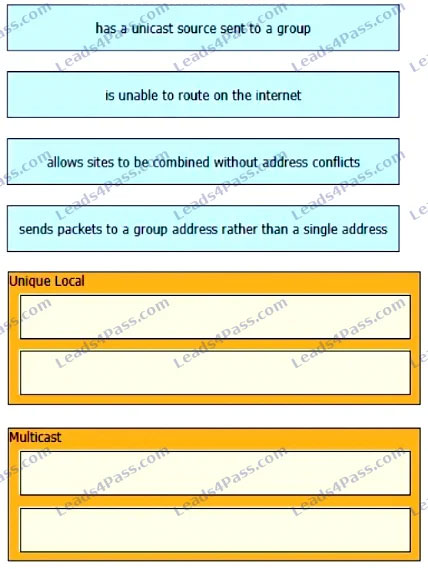
Drag and drop the characteristic from the left onto the IPv6 address type on the right.
Question 33
Single choice
Which service is missing when RADIUS is selected to provide management access to the WLC?
A.authorization
B.authentication
C.accounting
D.confidentiality
Question 34
Single choice
Which cable type must be used when connecting two like devices together using these criteria?
1. Pins 1 to 3 and 2 to 6 are required.
2. Auto detection MDI-X is unavailable.
A.straight-through
B.console
C.crossover
D.rollover
Question 35
Single choice
When OSPF learns multiple paths to a network, how does it select a route?
A.For each existing interface, it adds the metric from the source router to the destination to calculate the route with the lowest bandwidth.
B.It counts the number of hops between the source router and the destination to determine the route with the lowest metric.
C.It divides a reference bandwidth of 100 Mbps by the actual bandwidth of the exiting interface to calculate the route with the lowest cost.
D.It multiples the active K values by 256 to calculate the route with the lowest metric.
Question 36
Single choice
Refer to the exhibit.
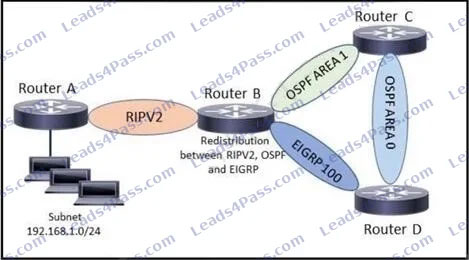
When an administrator executes the show ip route command on router D to view its routing table, which value is displayed for the administrative distance for the route to network 192.168 1.0?
A.110
B.120
C.170
D.90
Question 37
Single choice
Refer to the exhibit.
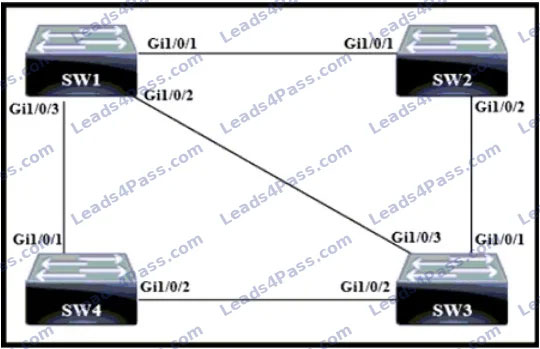
Which switch becomes the root bridge?
A.SW 4
Bridge Priority – 49152
mac-address 06:8e:bc:7e:5b:85
B.SW 3
Bridge Priority – 49152
mac-address 0d:e4:96:da:ee:95
C.SW 1
Bridge Priority – 36864
mac-address 05:a7:23:5b:52:25
D.SW 2
Bridge Priority – 36864
mac-address 04:1e:c4:bf:02:55
Question 38
Single choice
Refer to the exhibit.
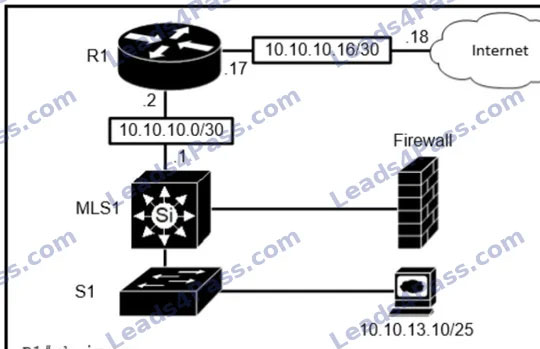
Which route type is configured to reach the Internet?
A.network route
B.floating static route
C.host route
D.default route
Question 39
Single choice
How do TCP and UDP fit into a query-response model?
A.TCP establishes a connection prior to sending data, and UDP sends immediately.
B.TCP uses error detection for packets, and UDP uses error recovery.
C.TCP avoids using sequencing, and UDP avoids using acknowledgments.
D.TCP encourages out-of-order packet delivery, and UDP prevents re-ordering.
Question 40
Single choice
What is a function of an endpoint?
A.It is used directly by an individual user to access network services
B.It passes unicast communication between hosts in a network
C.It transmits broadcast traffic between devices in the same VLAN
D.It provides security between trusted and untrusted sections of the network.
Question 41
Lab simulation
Simulation
Guidelines
This is a lab item in which tasks will be performed on virtual devices
1. Refer to the Tasks tab to view the tasks for this lab item.
2. Refer to the Topology tab to access the device console(s) and perform the tasks
3. Console access is available for all required devices by clicking the device icon or using the tab(s) above the console window
4. All necessary preconfigurations have been applied
5. Do not change the enable password or hostname for any device
6. Save your configurations to NVRAM before moving to the next item
7. Click Next at the bottom of the screen to submit this lab and move to the next question
8. When Next is clicked the lab closes and cannot be reopened
Topology
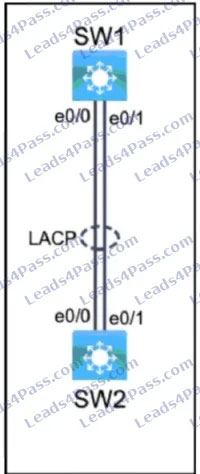
Tasks
Physical connectivity is implemented between the two Layer 2 switches, and the network connectivity between them must be configured.
1. Configure an LACP EtherChannel and number it as 44; configure it between switches SW1 and SW2 using interfaces Ethemet0/0 and Ethernet0/1 on both sides. The LACP mode must match on both ends.
2. Configure the EtherChannel as a trunk link.
3. Configure the trunk link with 802.1q tags.
4. Configure VLAN ‘MONITORING’ as the untagged VLAN of the EtherChannel.
Question 42
Multiple choice
What are two recommendations for protecting network ports from being exploited when located in an office space outside of an IT closet? (Choose two)
A.configure static ARP entries
B.enable the PortFast feature on ports
C.implement port-based authentication
D.configure ports to a fixed speed
E.shut down unused ports
Question 43
Single choice
By default, how does EIGRP determine the metric of a route for the routing table?
A.It uses the bandwidth and delay values of the path to calculate the route metric.
B.It uses a default metric of 10 for all routes that are learned by the router.
C.It counts the number of hops between the receiving and destination routers and uses that value as the metric.
D.It uses a reference bandwidth and the actual bandwidth of the connected link to calculate the route metric.
Question 44
Single choice
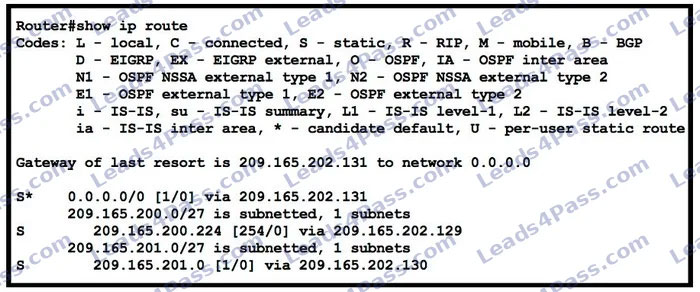
Refer to the exhibit.
Which command configures a floating static route to provide a backup to the primary link?
A.ip route 0.0.0.0 0.0.0.0 209.165.202.131
B.ip route 209.165.201.0 255.255.255.224 209.165.202.130
C.ip route 0.0.0.0 0.0.0.0 209.165.200.224
D.ip route 209.165.200.224 255.255.255.224 209.165.202.129 254
Question 45
Single choice
Which advantage does machine learning offer for network security?
A.It improves real-time threat detection.
B.It manages firewall rule sets.
C.It enforces password complexity requirements.
D.It controls VPN access permissions.
Question 46
Drag and drop
DRAG DROP
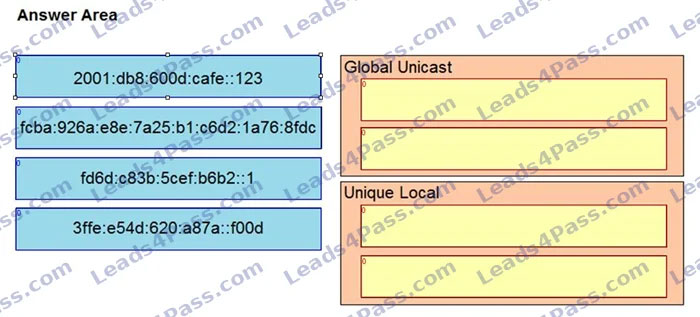
Drag and drop the IPv6 addresses from the left onto the corresponding address types on the right.
Question 47
Single choice
Refer to the exhibit.
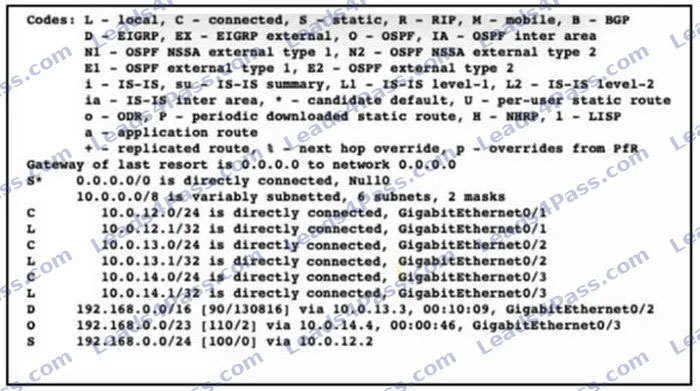
Which interface is chosen to forward traffic to the host at 192.168.0.55?
A.GigabitEthernet0/3
B.Null0
C.GigabitEthernet0/1
D.GigabitEthernet0/2
Question 48
Multiple choice
A network architect planning a new Wi-Fi network must decide between autonomous, cloud-based, and split MAC architectures.
Which two facts should the architect consider? (Choose two.)
A.Cloud-based architectures uniquely use the CAPWAP protocol to communicate between access points and clients.
B.Autonomous architectures exclusively use tunneling protocols to manage access points remotely.
C.All three architectures use access points to manage the wireless devices connected to the wired infrastructure.
D.Lightweight access points are solely used by split MAC architectures.
E.Each of the three architectures must use WLCs to manage their access points.
Question 49
Single choice
Refer to the exhibit.
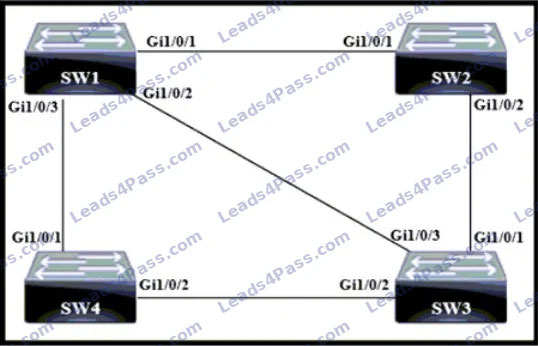
Which switch becomes the root bridge?
A.SW3
Bridge Priority – 28672
mac-address 00:10:a1:51:57:51
B.SW2
Bridge Priority – 28672
mac-address 00:10:a1:82:03:94
C.SW1
Bridge Priority – 12288
mac-address 00:10:a1:95:2b:77
D.SW4
Bridge Priority – 12288
mac-address 00:10:a1:03:42:e8
Question 50
Drag and drop
DRAG DROP
Drag and drop the SNMP manager and agent identifier commands from the left onto the functions on the right
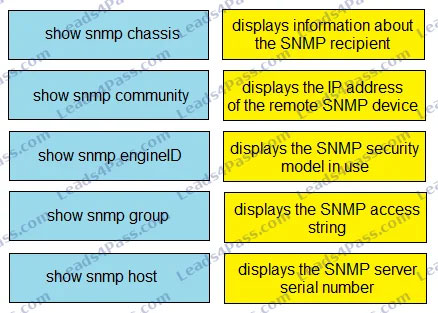
…
Diagnose the Mistake Before Choosing What to Study
The most important step happens after you check your answers. A wrong answer tells you that something went wrong, but it doesn’t identify the cause. Before opening a textbook or launching another practice test, work out what the error suggests and verify that explanation with a similar problem or a short explanation in your own words.
Use four practical categories to guide your review.
| Type of mistake | What it looks like | Best next action |
| Missing knowledge | You cannot explain the rule or concept behind the answer. | Relearn the concept and explain it without notes. |
| Confused concepts | You know the terms but mix up their functions or conditions. | Compare the concepts side by side and identify when each applies. |
| Application difficulty | You understand the rule but cannot use it in a configuration or troubleshooting scenario. | Work through a lab, topology, or worked problem. |
| Question interpretation | You know the material but overlook a requirement, limitation, or important condition. | Practise identifying the decisive wording before answering. |
These categories are diagnostic hypotheses, not proof of what caused a mistake. You need to check whether your explanation fits the evidence before deciding what to study.
Example 1: A Subnetting Answer Is Wrong
Suppose a question asks you to identify the usable host range for 192.168.10.64/27, and you choose the wrong range. Simply repeating subnetting exercises may not solve the problem because several different errors can produce the same result.
A /27 prefix leaves five host bits, giving 32 addresses per subnet. In this example, the subnet runs from 192.168.10.64 through 192.168.10.95; the network address is .64, the broadcast address is .95, and the conventional usable host range is .65 through .94.Consider three possible causes:
- Missing knowledge: You cannot explain how a
/27prefix leaves five host bits. Review CIDR notation and the relationship between prefix length and subnet size before attempting more calculations. - Application difficulty: You know that each subnet contains 32 addresses but calculate the boundary incorrectly. Practise finding block sizes and network boundaries across several different prefixes.
- Question interpretation: You calculate the correct subnet but include the network or broadcast address in the usable host range. Practise distinguishing the total address range from the usable host range.
The answer is the same in each case: the original response was wrong. The next study task, however, should differ depending on the cause.
To verify your diagnosis, solve a new subnetting problem with a different network address and prefix. Explain the network address, broadcast address, and usable range before checking the result. If you can consistently complete that process, you have stronger evidence of understanding than you would get from memorizing the original answer.
Example 2: A VLAN Connectivity Problem
Imagine a question describes two hosts in different VLANs that cannot communicate, and asks what network function is required for communication between them.
If you know what VLANs are but assume that a Layer 2 switch will automatically route traffic between them, the problem may be confusion between switching and routing. Review the role of Layer 2 forwarding, the purpose of a default gateway, and the function of inter-VLAN routing. Then trace how a packet moves from a host in one IP subnet to a host in another.
If you understand those concepts but cannot determine whether a particular topology supports inter-VLAN routing, the problem is more likely application difficulty. Draw the topology, identify the VLAN assignments and IP subnets, and inspect the relevant Layer 3 interfaces or switch virtual interfaces. Ask yourself whether a functioning Layer 3 path exists between the two networks.
A third possibility is that you overlooked a detail in the question. Perhaps the scenario specifies that the switch is operating only at Layer 2, or that the hosts belong to the same VLAN. In that case, reread the scenario and identify the condition that determines the answer before reviewing routing theory.
The practical sequence is straightforward: observed error → likely cause → verification → next study action. Apply it to each significant mistake, and your practice results will start to tell you what to do instead of merely telling you what you got wrong.
Turn Your Results into a Focused Study Plan
After classifying your mistakes, group them by exam topic. You might discover that several incorrect answers involve IPv4 subnetting, while others concern DHCP, routing tables, or switch configuration. That pattern helps you decide where to concentrate your next study session.
Cisco’s official exam objectives provide a useful reference for organizing this work. The current v1.1 exam covers network fundamentals, network access, IP connectivity, IP services, security fundamentals, and automation and programmability. The upcoming v2.0 blueprint uses a revised structure and weighting, so use the objectives that correspond to your exam version rather than mixing the two indiscriminately.
Your review plan should connect each weakness to a specific activity.
| When foundational knowledge is missing Return to the relevant lesson or documentation. For example, if you cannot explain the purpose of a default gateway, study how hosts forward traffic to destinations outside their local subnet. Then explain the process without relying on notes. |
| When two concepts are confused Compare their functions and the conditions under which each applies. If you mix up access ports and trunk ports, explain which VLAN traffic each carries and how 802.1Q tagging relates to trunk links. |
| When applying knowledge is difficult Use a topology, configuration exercise, or troubleshooting scenario. For routing questions, inspect the destination prefix and relevant routing-table entries, then determine which route the router would select. |
| When question interpretation is the problem Before answering, identify the requested outcome, any stated constraints, and the details that distinguish the available options. Practise explaining why each incorrect option fails under the conditions given. |
Where to Find Additional CCNA 200-301 Practice Materials
Once you’ve identified the topics that need more work, additional practice can help you explore them from different angles. The key is to choose material that supports your diagnosed weakness rather than simply adding more questions to your study routine.
You can explore CCNA 200-301 preparation materials from Leads4Pass as one possible source of supplementary practice. Before purchasing, check the exam version, the availability of answer explanations, and whether the material addresses the objectives relevant to your exam date. Leads4Pass is a third-party provider, not an official Cisco resource.
Additional question banks are most useful when you use them to investigate a specific gap, verify your understanding with unfamiliar scenarios, and identify any remaining misconceptions. They should complement your learning resources and hands-on practice, not replace them.
Conclusion
Your 50 CCNA practice questions are a starting point for a more focused study process. A wrong answer becomes useful when you identify its likely cause, choose an appropriate review activity, and test yourself with a fresh problem. Keep track of what you discover, prioritize weaknesses that repeatedly affect your performance, and adjust your plan as your understanding improves.
The goal isn’t simply to get more questions right. It’s to understand why the correct answer works and apply that reasoning when the scenario changes.
Comments on 'How to Turn CCNA 200-301 Practice Questions into a Targeted Study Plan' (0)
Comments Feed
Comments are closed.